| dc.contributor.author | Sparić, Radmilla | |
| dc.contributor.author | Hatırnaz, Şafak | |
| dc.contributor.author | Tinelli, Andrea | |
| dc.date.accessioned | 2025-12-18T06:39:10Z | |
| dc.date.available | 2025-12-18T06:39:10Z | |
| dc.date.issued | 2025 | en_US |
| dc.identifier.citation | Sparić R, Hatirnaz S and Tinelli A (2025) Editorial: Uterine fibroid surgery in gynecology and obstetrics and reproduction: lights and shadows. Front. Surg. 12:1698612. | en_US |
| dc.identifier.issn | 2296-875X | |
| dc.identifier.uri | https://www.frontiersin.org/journals/surgery/articles/10.3389/fsurg.2025.1698612/full | |
| dc.identifier.uri | https://doi.org/10.3389/fsurg.2025.1698612 | |
| dc.identifier.uri | https://hdl.handle.net/20.500.12780/1292 | |
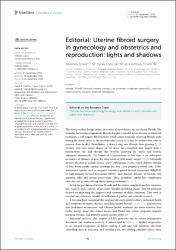
| dc.description.abstract | The most prevalent benign tumors in women of reproductive age are uterine fibroids. The mainstay for treating symptomatic fibroids that don't respond to less invasive or medicinal treatments is still surgery. Myomectomy, which entails surgically removing fibroids while leaving the uterus intact, is the recommended course of action for women who want to preserve their fertility. Nevertheless, it doesn't stop new fibroids from growing (1–5). Women who have severe disease or no desire for conception may benefit from a hysterectomy, the final therapy that involves removing the uterus and resolves symptoms permanently. The benefit of a hysterectomy is that there is no subsequent recurrence of fibroids, despite the risks involved with major surgery (3, 6). Minimally invasive alternatives include uterine artery embolization (UAE), which deprives fibroids of their blood supply causing shrinkage but may carry pregnancy-related risks. Other noninvasive options such as magnetic resonance-guided focused ultrasound (MRgFUS) or high-intensity focused ultrasound (HIFU) offer thermal ablation of fibroids with symptom relief and uterine preservation. These modalities exhibit low complication rates and suit patients seeking uterus-sparing treatments (1, 3, 7). | en_US |
| dc.language.iso | eng | en_US |
| dc.publisher | Frontiers Media SA | en_US |
| dc.relation.isversionof | 10.3389/fsurg.2025.1698612 | en_US |
| dc.rights | info:eu-repo/semantics/openAccess | en_US |
| dc.subject | Fibroid | en_US |
| dc.subject | STUMP (smooth muscle tumours of uncertain malignant potential) | en_US |
| dc.subject | Cesarean myomectomy | en_US |
| dc.subject | Surgery | en_US |
| dc.subject | Artificial inteligence | en_US |
| dc.title | Editorial: Uterine fibroid surgery in gynecology and obstetrics and reproduction: Lights and shadows | en_US |
| dc.type | article | en_US |
| dc.contributor.department | İstanbul Kent Üniversitesi, Fakülteler, Sağlık Bilimleri Fakültesi, Ebelik Bölümü | en_US |
| dc.contributor.authorID | 0000-0001-8859-0639 | en_US |
| dc.contributor.institutionauthor | Hatırnaz, Şafak | |
| dc.identifier.volume | 12 | en_US |
| dc.relation.journal | Frontiers in Surgery | en_US |
| dc.relation.publicationcategory | Makale - Uluslararası Hakemli Dergi - Kurum Öğretim Elemanı | en_US |